
MBBS (AIIMS), MS (Surgery, AIIMS), MNAMS, FACS (USA), FICS (USA), FUICC
Mon, 21 Sep 2026
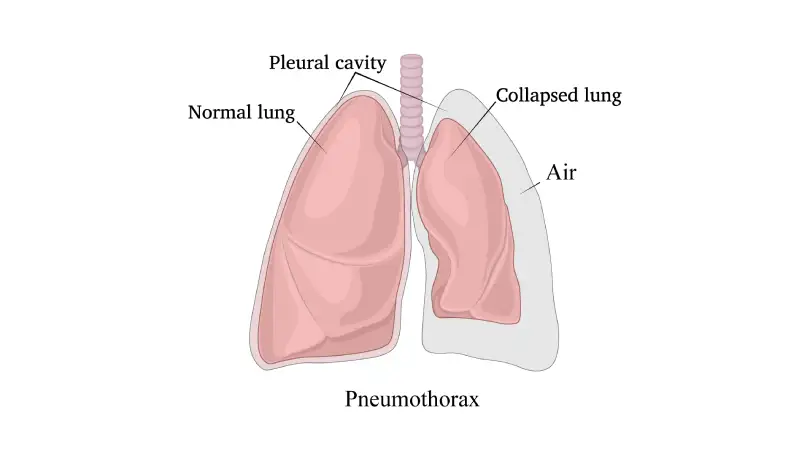
Pneumothorax is a condition in which the lung deflates or collapses, either partially or completely, because air enters the pleural space — the space between the chest wall and the lung. This pushes on the lung’s outer surface, preventing it from expanding and causing breathing problems that need prompt clinical attention.
Dr. Arvind Kumar provides advanced pneumothorax treatment in India, with sophisticated diagnostic and therapeutic options to restore full lung function.
The lung collapses due to air leaking into the pleural cavity without any traumatic injury. This has two forms: primary spontaneous pneumothorax, which occurs without an underlying lung condition and is more common in tall, slim individuals; and secondary spontaneous pneumothorax, which happens due to pre-existing conditions such as COPD, asthma, or cystic fibrosis.
The chest is severely injured by external trauma affecting the lung region — from accidents, rib fractures, or a previous surgical procedure. Identifying the underlying cause is important, as it determines the treatment route.
Damage to the pleura allows air to enter and become trapped, unable to be released, creating pressure between the pleura and the lung. This prevents the lung from expanding, leading to difficulty breathing.
Dr. Arvind Kumar conducts a physical examination to assess the severity of lung collapse, checking for minimized chest movement on one side, a hyper-resonant percussion note, and asymmetrical chest wall movement during breathing.
A chest X-ray gives a clear view of the pleural space and the collapsed lung margin; for complex cases, a high-resolution CT scan helps identify the exact site of air leaks and detect underlying lung disease or small blebs.
If only a small portion of the lung has collapsed, the condition may simply be monitored over several weeks with a series of X-rays and CT scans, until the excess air is absorbed and the lung has re-expanded.
For a larger collapse, Dr. Kumar uses a minimally invasive technique — inserting a hollow needle with a small flexible tube between the ribs into the air-filled pleural space, then attaching a syringe to extract the excess air. The catheter is kept in place for a few hours to confirm the lung has re-expanded properly.
For severe or recurrent pneumothorax, VATS is used as the initial surgical approach — a small incision allows a specialized camera to examine the pleural space and identify the underlying blebs or bullae causing air leaks, treating recurrent and persistent pneumothorax with less postoperative pain and a shorter hospital stay.
In severe cases where VATS is not a feasible option, Dr. Kumar performs a thoracotomy through a larger incision between the ribs, giving direct access to the entire thoracic cavity to manage extensive pleural adhesions or significant lung damage. A pleurectomy may also be performed to support lung stability after the operation.
This procedure closes the gap between the pleural layers to prevent lung collapse. Dr. Kumar uses agents such as talc or doxycycline to irritate the pleural layers so they adhere together, sealing the space and preventing fluid buildup or the re-entry of air. Pleurodesis is often used for patients with pleural effusions related to cancer, or fluid buildup from conditions such as nephrotic syndrome or heart failure.
Pneumothorax treatment cost in India generally ranges between ₹1 lakh and ₹5 lakh.
| Component | Cost (₹) |
|---|---|
| Consultation | 1,000–2,000 |
| Diagnostic evaluation | 6,000–10,000 |
| Chest tube insertion | 8,000–20,000 |
| Needle aspiration | 2,000–5,000 |
| VATS pneumothorax surgery | 90,000–2,20,000 |
| Traditional open surgery | 1,50,000–3,00,000+ |
| Pleurodesis | 10,000–3,00,000 |
For patients with prolonged or repeated pneumothorax, Dr. Arvind Kumar identifies the root cause of the recurring collapse, such as underlying blebs, before starting treatment.
Alongside diagnosis, he reviews each patient’s lung condition and clinical history to prescribe an individualized treatment plan.
VATS and other minimally invasive techniques help reduce surgical trauma to the chest, so patients experience less pain and a smoother recovery.
Dr. Kumar prioritizes durable solutions for securing the lung membrane, aiming to improve the longevity of respiratory health.
If you are experiencing sudden chest pain or breathing difficulty, it could be an early sign of pneumothorax. Prompt evaluation matters — for a Delhi-focused overview, see our Pneumothorax Treatment in Delhi page.
Make an appointment with Dr. Arvind Kumar and start your treatment now.

Dr. Arvind Kumar is a highly accomplished Chest surgeon with experience of over 20,000 major chest surgeries, including open surgery, VATS(Video assisted Thoracic Surgery), Robotic Chest Surgery, and Lung Transplantation, reflecting decades of clinical excellence and leadership in chest surgery.
Copyright @ (Prof.) Dr. Arvind Kumar. All Rights Reserved / Thoracic Surgical Oncologist
License Number: U.P State Medical Council (India) No. 27637


 Contact
 +91-9773635888