
 Contact
 +91-9773635888
Who Needs a Thymectomy? Understanding the Indications
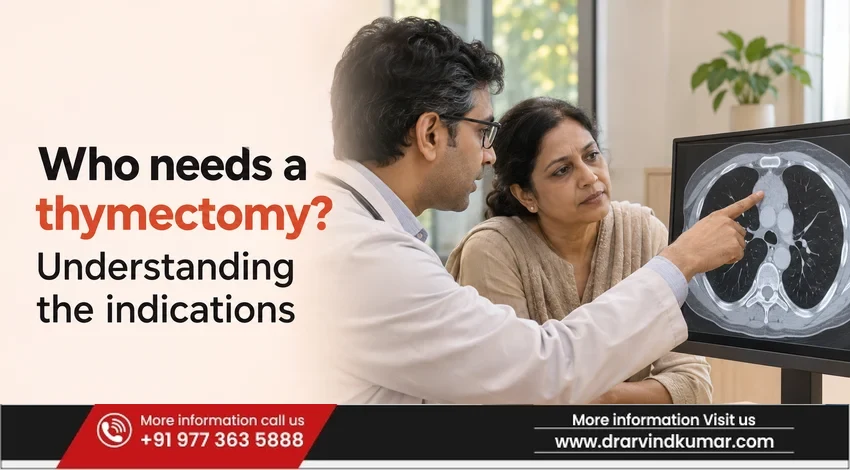
Who needs a thymectomy? Two groups of patients: people with a tumor of the thymus gland (a thymoma or thymic carcinoma) and some people with myasthenia gravis, an autoimmune condition that causes muscle weakness. A thymectomy is the surgical removal of the thymus, a small organ in the upper chest just behind the breastbone. Our robotic thymectomy page explains the operation itself, and this guide explains who it is meant for.
The thymus matters most in childhood, when it helps train the immune system. By adulthood it has largely finished that job, which is why it can usually be removed without any noticeable loss of function. If you are still at the stage of asking what a thymus tumor looks like in practice, our article on thymoma symptoms and diagnosis is a good place to start.
When is a thymectomy needed for a thymoma or thymic tumor?
A thymoma is a tumor that arises from the thymus itself, and it is the most common reason a thymectomy is scheduled. Thymomas sit in the anterior mediastinum, the space just behind the sternum, and many are found by chance on a chest CT (computed tomography) scan done for another reason. Thymic carcinoma, a more aggressive cancer of the same gland, is much less common but starts with the same surgical approach.
Not every thymic mass is cancer. Thymomas range from low-risk growths that rarely spread to invasive types that can grow into nearby structures such as the pericardium or major blood vessels. Surgeons usually remove the whole thymus, not just the visible tumor, because other parts of the gland can hold microscopic disease that a scan will not show. Tumor size, its appearance on imaging and any sign of invasion decide how soon surgery is planned and whether chemotherapy or radiation is added before or after. Our guide to types of thymoma and surgical treatment options covers this in more detail, and the thymoma treatment page explains how care is planned.
When is a thymectomy advised for myasthenia gravis?
Myasthenia gravis is an autoimmune disease in which antibodies disrupt the signal between nerves and muscles. The weakness it causes tends to build with activity and ease with rest. The thymus is closely tied to this process: in many patients the gland is enlarged or structurally abnormal, a finding called thymic hyperplasia. Removing it can lower symptom severity and reduce the need for medicines in a meaningful share of patients, even when no tumor is present. Our article on myasthenia gravis and its treatment explains the condition and the other treatments used alongside surgery.
Age and antibody type both shape the advice. Surgery is usually weighed most favorably in younger patients who have generalized disease and a particular antibody pattern. The decision is shared between the neurologist who manages the myasthenia and the thoracic surgeon who would operate. Not every patient with myasthenia gravis is a candidate, and the neurologist's assessment of the disease pattern and severity carries real weight.
How do doctors decide that surgery is the right step?
They weigh the expected benefit of removing the thymus against the risk of a chest operation for that particular patient. For a thymoma the answer is usually clear once imaging shows a mass that needs to come out. For myasthenia gravis without a tumor, the decision leans more on disease severity, how well symptoms are controlled with medicine alone, and whether the patient is young and fit enough to gain lasting benefit from surgery.
A contrast CT scan of the chest is the starting point in both situations. Blood tests for myasthenia-specific antibodies and, where a tumor is suspected, markers linked to other thymic or germ cell tumors complete the work-up before surgery is booked.
What surgical approaches are available?
An open thymectomy uses a traditional incision down the center of the chest and gives the surgeon direct, wide access to the whole gland. It remains the right choice for large or locally invasive thymomas, where full visibility and room to work around major vessels are needed.
Recovery is the main reason video-assisted thoracoscopic surgery (VATS) has largely replaced open surgery for smaller cases. A few small incisions and a camera replace the long incision, and in experienced hands VATS can remove the thymus as completely as open surgery for most myasthenia gravis cases and smaller tumors. You can read more about it on our VATS surgery page.
Add a magnified 3D camera and wrist-like instruments to the same small-incision idea and the result is robotic-assisted thoracic surgery (RATS), used for robotic thymectomy. The extra range of movement helps in a tightly packed space like the mediastinum, where precise handling near the heart and great vessels matters. At this practice, a minimally invasive approach (VATS or robotic) is used whenever tumor size and extent make it safe, and open surgery is kept for the cases that need it.
What does recovery usually look like?
Recovery depends on the approach. After an open thymectomy most patients stay in hospital for several days and need a few weeks before returning to normal activity, with some chest wall discomfort in that period. After VATS or robotic thymectomy the hospital stay is usually shorter, often a day or two, and normal activity tends to return sooner because there is no large muscle incision to heal. Recovery times vary from patient to patient.
For patients operated on for myasthenia gravis, improvement is not usually immediate. It can take months, and sometimes more than a year, for the full effect on muscle strength and medicine needs to become clear. It helps to set that expectation before the operation rather than after.
This article is for general education and does not replace a consultation with a thoracic surgeon or neurologist. Whether a thymectomy is right for a specific thymic tumor or case of myasthenia gravis depends on individual factors that only a specialist can assess.