
 Contact
 +91-9773635888
Esophagectomy for Esophageal Cancer: What the Surgery Involves and How Recovery Goes
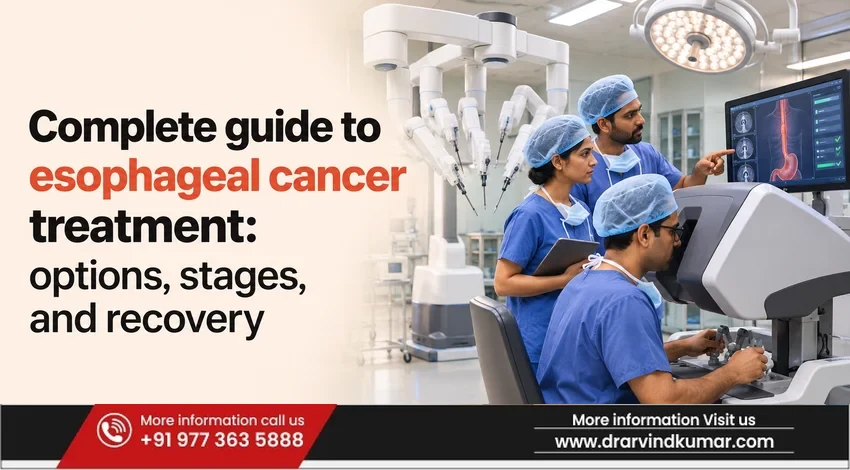
Esophagectomy for esophageal cancer means removing the diseased part of the esophagus and rebuilding the food passage, usually with the stomach. Whether it is the right step depends on one factor above all: how far the cancer has spread when it is diagnosed. Our esophageal cancer treatment page covers tumor types, staging and chemoradiotherapy in depth. This guide explains how stage drives the decision, what the operation involves and what the weeks after surgery look like. For the wider picture, see our complete guide to esophageal cancer treatment in India.
How does the stage decide the treatment path?
The stage decides the mix of surgery, chemotherapy and radiation a patient is offered. Surgery alone can treat a meaningful share of esophageal cancers caught early, while the tumor is still confined to the esophageal wall and has not reached nearby lymph nodes. Some very early, superficial tumors can be removed endoscopically, through a scope passed down the throat, without open or laparoscopic surgery. Others need a formal esophagectomy, sometimes preceded by a short course of chemotherapy or chemoradiotherapy to shrink the tumor first. Which path applies depends on how deep the tumor has grown into the esophageal wall, which endoscopic ultrasound and biopsy results spell out before any decision is made.
Once the tumor pushes through the esophageal wall or turns up in nearby lymph nodes, surgery by itself is usually not enough. The standard approach combines chemotherapy and radiation given together over several weeks, followed by surgery once that treatment has had time to shrink the tumor and clear microscopic disease that scans cannot pick up. This sequence, chemoradiotherapy before esophagectomy, is the backbone of locally advanced treatment at most major cancer centers. A smaller group of patients, particularly those who respond very well to chemoradiotherapy or who are not fit for a major operation, are managed with chemoradiotherapy alone and close monitoring instead.
By the time scans show spread to the liver, lungs, bones or distant lymph nodes, the goal of treatment shifts. Removing the esophagus does not extend survival at this stage and is not recommended. Treatment centers instead on systemic therapy, meaning chemotherapy and, increasingly, targeted drugs or immunotherapy matched to the tumor's biology, aimed at controlling the disease, easing swallowing difficulty and protecting quality of life. A feeding tube or an esophageal stent sometimes helps when the tumor itself is narrowing the passage.
What does an esophagectomy involve?
Esophagectomy means removing the diseased section of the esophagus, almost always along with the surrounding lymph nodes, then rebuilding a working passage for food. In most cases the stomach is pulled up into the chest and joined to the remaining esophagus, so the patient can eat and swallow again once healing is complete. Occasionally, when the stomach cannot be used, a segment of colon is used instead.
Surgeons reach the esophagus in a few different ways. An open approach uses larger incisions in the chest and abdomen. A minimally invasive approach does the same dissection through several small incisions using a camera and long instruments, and a robotic approach uses a surgical robot for finer control in the tight space of the chest cavity. The reconstruction is largely the same whichever approach is used. What changes is how much trauma the body goes through to get there.
This is major surgery either way. It typically takes several hours, involves a team that includes thoracic surgeons and anesthesiologists trained in chest surgery, and is usually followed by a short stay in intensive care while breathing and heart function are monitored closely.
Why did minimally invasive and robotic surgery change recovery?
Smaller incisions mean less damage to the chest wall muscles and ribs. That means less pain after surgery and an easier time breathing deeply and coughing, both of which matter for avoiding pneumonia in the first days after an esophagectomy. Patients who have had minimally invasive or robotic surgery tend to get out of bed and start walking sooner, which speeds up recovery of lung function and digestion.
Robotic systems add precision in a part of the chest where visibility is naturally limited. Surgeons get a magnified, three-dimensional view and instruments that move in ways a human wrist cannot, which helps with the delicate lymph node removal that accurate staging depends on. None of this makes the surgery less serious. It means the body does not have to recover from the access route on top of the operation itself. You can read more about this approach on our robotic thoracic surgery page.
What does recovery look like after esophagectomy?
Most patients spend roughly one to two weeks in hospital in total, with the first day or two in intensive care, though this varies with how the surgery went and how quickly breathing and gut function recover. After intensive care, most patients move to a regular surgical ward.
Eating does not start the way most people expect. The new connection between stomach and esophagus needs time to heal before it can handle food, so nutrition in the early days comes through a feeding tube, often placed directly into the small intestine during the original surgery. A swallow study, an X-ray that checks that the join is healed and watertight, usually clears the way for sips of liquid first, then soft food, then a gradual return to more normal eating over several weeks.
Even after that, eating habits have to change for the long term. Meals need to be smaller and more frequent, because the stomach that once sat below the diaphragm is now partly in the chest and holds less at a time. Many patients deal with dumping syndrome, a rush of food into the small intestine that causes sweating, cramping or lightheadedness, especially after sugary foods. Most learn to manage it within a few months by adjusting what and how they eat.
Return to normal daily activity generally takes six to eight weeks for most tasks, with full strength and stamina sometimes taking a few months longer. Walking starts in the hospital, often the day after surgery, and builds gradually. Driving, lifting and returning to physically demanding work usually wait until the surgeon has confirmed that the chest and abdominal incisions have healed. Recovery varies from patient to patient. If you are unsure whether a symptom needs attention, our guide on when to see a chest surgeon explains the warning signs.
This article is meant to help you understand the general shape of esophageal cancer treatment, not to replace a conversation with your own surgeon or oncologist. Staging, overall health and how a tumor responds to treatment vary enough from one patient to the next that only your treating team can map out what applies to your case.